
Step 01 · Inputs
Land, water, hedge, hands.
We hold two allotment sites in the parish on perpetual trust. Each February we set fair plot rents and budget for water, manure, hedge-laying and shed repair. Volunteers give roughly 2,100 hours a year.
Our mission
Our charitable object is one short clause. Everything below is what we have made of it after a hundred years of trying — including the bits we got wrong.
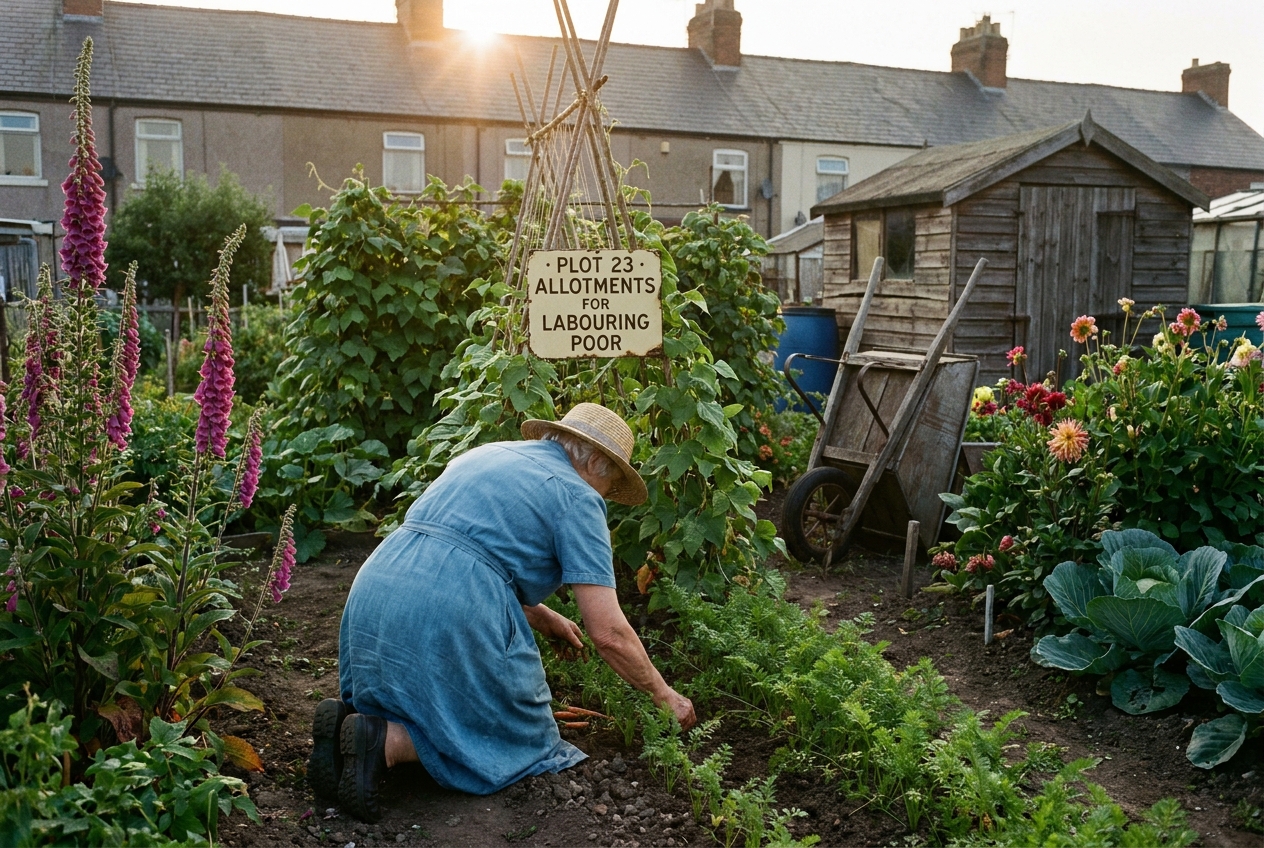
Our object, in the words of the 1970 scheme
The provision of allotments for labouring poor in the ancient parish of Mansfield.
That is the entire charitable object of the trust, taken word-for-word from the scheme sealed by the Charity Commission on the 6th of October 1970. It carries forward the original 1916 scheme without softening it. We have never tried to broaden it. We have, on more than one occasion, been gently encouraged to do so — to add a research arm, a campaigns arm, a national policy voice — and we have, on each occasion, said no.
Our reasoning is the reasoning of the long view. A charity that has done one thing for a hundred years is unusual, and we believe it is unusual because narrowness is a kind of strength. Plots have to be let well or there is nothing. So the trust lets plots well, and lets other people do other things.
We are an allotment trust, so our theory of change has the shape of a growing season — input, plot, harvest — rather than the long horizontal arrow of a policy paper. Here it is in three frames.
Step 01 · Inputs
We hold two allotment sites in the parish on perpetual trust. Each February we set fair plot rents and budget for water, manure, hedge-laying and shed repair. Volunteers give roughly 2,100 hours a year.
Step 02 · Plot
Plots are let in three sizes — quarter, half, full. The waiting list runs about 18 months. Rents start at £18 a year. The site committee meets once a quarter to keep it all going.
Step 03 · Outcomes
Tenants grow their own. Soil organic matter on tended plots is up roughly twofold since the 1970s. The Common Plot fed the Beacon Project foodbank 612 kg of fresh produce last year. Plots last on average 4.6 years per tenant.
Values written on a page are easy. The list below is meant to be read as habit — what we actually do on a Wednesday morning, not what we would like to be quoted as having said.
For most of the 2010s, our waiting list was effectively a paper-only secret. People who knew a trustee got on; people who did not know a trustee did not. We changed the policy in 2019, but we have not yet caught up with the families who quietly assumed they were not welcome. That is on us, and we are still working at it.
We have made other small mistakes. Three years in a row, between 2014 and 2017, we under-budgeted for water on hot summers and tenants paid for hosepipe extensions out of their own pockets. We over-built one path in 2020 with the wrong grade of stone and had to relay it the following spring. We let a section of hedge become hawthorn-and-bramble in 2016 because we lost the volunteer who used to lay it, and it has taken us eight winters to bring it back.
None of these are ruinous. All of them are honest. We mention them because trust is built on saying, plainly, where we have not yet got it right.
By the end of the decade we would like to have water on every path at Carr Bank, the western hedge fully laid, the schools programme reaching every primary in the parish that wants it, and the waiting list down to under a year. None of these are heroic. All of them are within our means if we keep doing the work, and you keep helping us pay for it.
Plain and small
Take out a plot. Volunteer at a hedge-laying day. Or just sign up to our four-times-a-year letter from the path.