
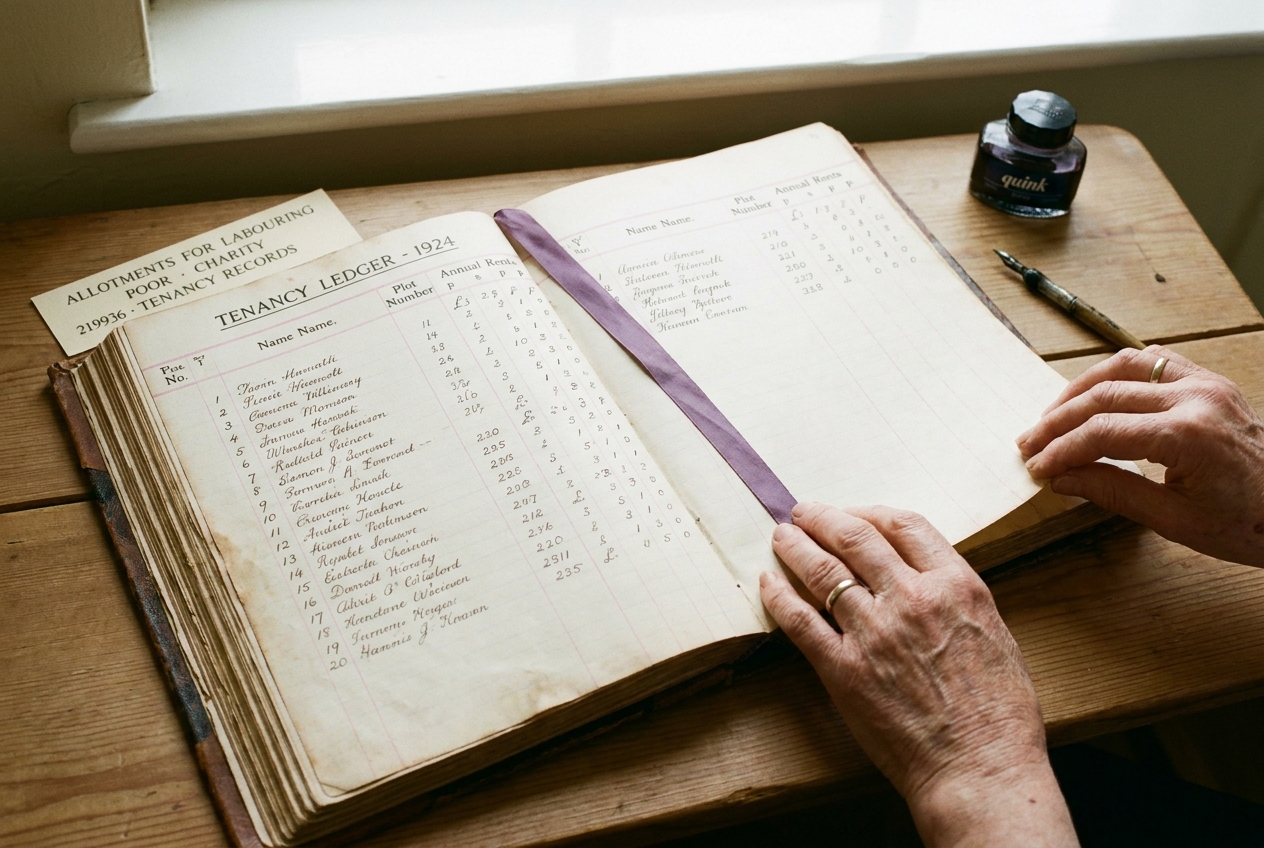
Last Saturday morning, in the upper room of Westgate Parish Hall, I sat with the 1924 tenancy ledger of the Allotments for Labouring Poor on a folded square of muslin, with a pair of cotton gloves on, and the upper sash window open an inch to let some air in. The ledger has been to and from the Nottinghamshire Archives in Castle Meadow three times since the trust acquired it, in pieces, in 1971, and it is at last in a state where it can be read without the spine threatening to give up.
I had gone to look up something else — a forgotten plot number from a query that had come in by post from a great-grandson in Australia — and I stayed, as I often do, for the long copperplate listings. They are addictive. The pages are foxed at the edges and the ink is brown rather than black now, but the hand is even, the columns are ruled in a beautifully steady purple pencil, and the rents are listed in pounds, shillings, and pence.
Plot 1. M. Thirling, weaver. 6d a year. Cancelled 1925, ill health. The shortest entry in the book, and the saddest.
I have read the first page perhaps twenty times in my fourteen years on the trust, and it still surprises me. Plot 1, the first plot under the second scheme of 1916 to be re-let after the war, went to a Mansfield weaver, M. Thirling, in March 1924. The rent was sixpence a year. Plot 2 went to a tram-conductor named E. Allen, also sixpence. Plot 3, the only full-size plot on the opening pages, went to a man listed simply as "Tobias W., labourer" at one shilling a year, with a note that he had asked to pay it in monthly halfpennies, and that the trustees had said yes.
The arithmetic of a very small rent.
Sixpence in 1924 is, in modern terms, somewhere between £1.50 and £2.50 depending on which inflation index you trust. It would buy you a quarter of a loaf of bread. A full-size plot rent of one shilling, twice that, would buy you half. Our rents today, set at £18 for a quarter-plot, are higher in real terms than the 1924 figures, but not by as much as you might think. The 1970 scheme explicitly permits the trustees to set fair rents, and we have, in 2014 and again in 2022, taken minutes that argue against putting the lowest band up.
The reason is in the founding deed. The trust exists for the labouring poor of the parish. Whatever a "labouring poor" is in 2026 — and we have argued about that in committee for three Februaries running — we have agreed that the bottom of the rent ladder should be reachable on a pension, on a benefit, on a single wage with three children at home. A quarter-plot at £18 is reachable. A full-size plot at £32 is, with care, reachable too.
What the ledger does not tell us.
The 1924 ledger lists names, occupations, rents, plot numbers, and the year each tenancy ended. It does not list addresses, and it never lists who actually worked the plot. Several of the early entries are clearly held in a husband's name where the wife and grown children did most of the digging — we know this from the side-notes our predecessors made in pencil. One entry, against Plot 17, has the word "the family of" inserted in a different hand. We have decided, in 2026, to include working partners on tenancy paperwork. The 1924 trustees would, I suspect, have approved.
The ledger does not tell us much, either, about who did not get a plot. The waiting list does not survive from this period. From the 1948 minutes onwards there are angry letters from labourers who had been told there was nothing for them, and we know that for at least a decade after the war, demand outstripped supply by a factor of three. The trust opened a second site at Pelham Street in 1953 partly in response to those letters. We have a copy of the first Pelham letting list in the safe.
What we are doing with the older books.
We are part-way through digitising the 1924, 1947, and 1962 ledgers. The work is being done, slowly and by hand, by a small group of volunteers including Jacob Pell, who comes up to the archive once a fortnight in his lunch hour, and Margaret Allbright, who joined the team last March and has the steadiest hands of any of us. We hope, by Spring 2027, to be able to publish a searchable PDF of the 1924 book on our website. We will not include private notes — cause of cancellation, side-comments on character — but the rents and the named tenants will be searchable.
If you are descended from a Mansfield plot-holder from the first half of the twentieth century, write to us. We can almost certainly find them.