The Common Plot at Carr Bank is one plot among 136. It is the third plot on the left as you walk in from the main gate. It has, this year, fed something in the order of 1,400 individual foodbank-bag recipients with one or another of its harvests. That sentence still surprises me when I read it back, and I have been the volunteer lead for the plot for three years now.
This is a year-end summary, written in early October as we close down the 2025 season at the Common Plot. We have, just, finished the last of the runner beans — the lateness of the autumn has been kind — and we have begun to lay out the cardboard mulch and the green manure that will overwinter the bed.
The headline figures.
- 612 kg of produce harvested and delivered to the Beacon Project foodbank between Friday 4 July and Friday 26 September 2025.
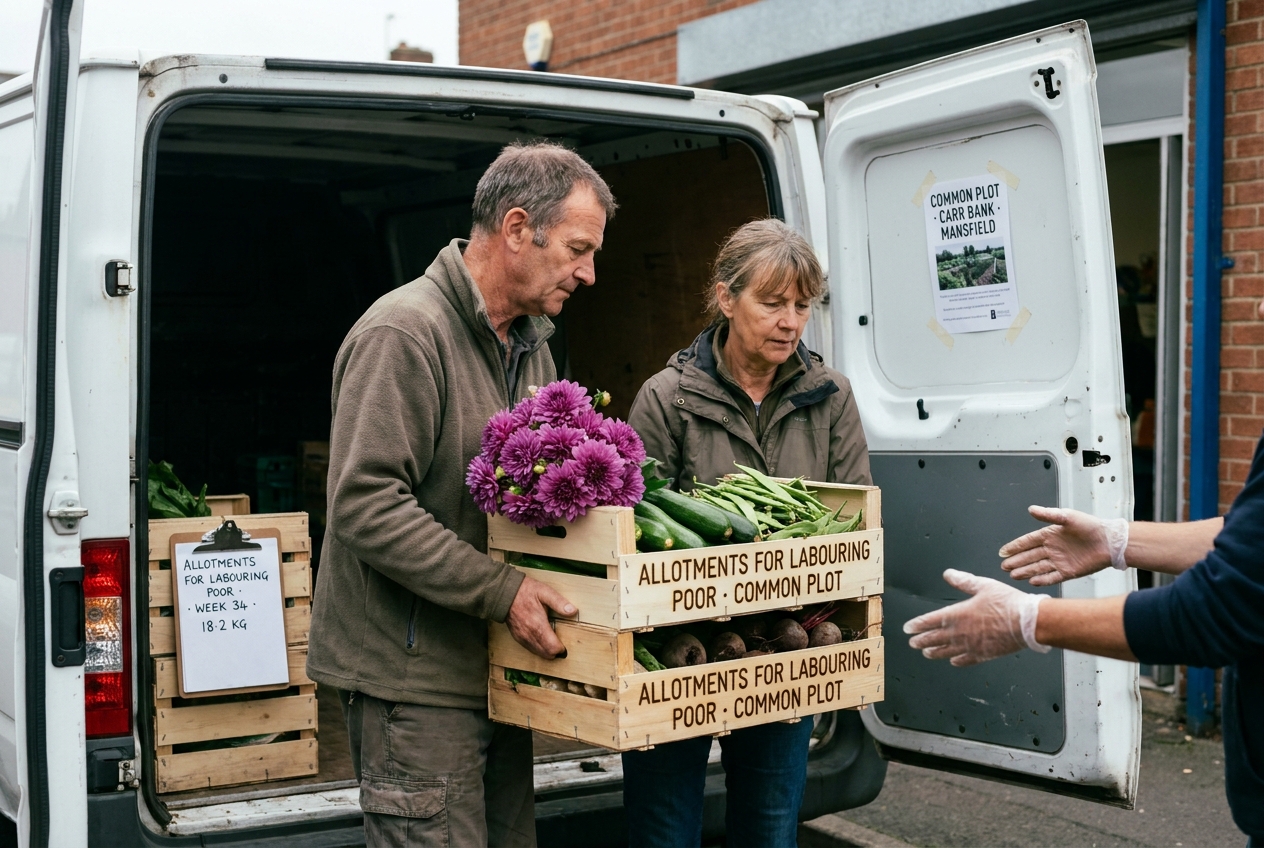
- 34 weekly deliveries, each made in person by a small team of two volunteers in a borrowed Vauxhall Combo from Walkden's of Mansfield.
- 11 named Saturday volunteers, plus three or four extras who came up when they could.
- One bunch of dahlias on top of every crate, as Margaret insists.
What grew this year.
Courgettes, more than we could quite distribute. Beetroot, which the foodbank can never get enough of. Runner beans, which divide opinion (some bag recipients love them, some find them tough). Chard, which is unfashionable and which I love. Kale, of three varieties, including a deep purple one called 'Redbor' that I will be planting more of next year. Onions, in two beds. Garlic, planted last October, lifted in July. Carrots, late and small, on a section of bed we now know was too compacted. Tomatoes, with a small new mid-plot polytunnel that I will write about separately in November. And the dahlias, which I have come to think of as part of the work, not a luxury alongside it.
A bag with a bunch of dahlias on top is not the same as a bag without one. We have heard this from the foodbank volunteers; we believe them.
The bit that went wrong.
The carrots. Three rows of Autumn King on a section of bed that we did not turn deeply enough at the start of April. The soil was too compacted; the carrots forked and split. We lifted them anyway and they made a thin layer of carrot in the foodbank crates for three weeks in September, but they were not what we had hoped for. The lesson, which we keep relearning: a Saturday spent forking a bed before you sow is never wasted.
What the foodbank says.
Sara at the Beacon Project tells us, gently, that the bags with our produce in them go out first when the queue is long. The reason is partly that the produce is visibly fresher than what you would buy at the end of a supermarket's day, partly that it is light enough to walk home with, and partly — she thinks — that the foodbank recipients have begun to recognise our chalk-marked crates and treat them as a small marker of seasonal pride. We do not know if that is true. We hope it is.
What we are planning for 2026.
A small polytunnel, paid for from the standpipe-adjacent capital underspend, to extend the tomato and courgette season by three weeks at each end. A second small bed of overwintering Tuscan kale, so that the foodbank has fresh greens in February. A reorganisation of the runner-bean wigwams to give two rows of climbing French beans instead, on the grounds that French beans freeze better and the foodbank's freezer is busier than its kitchen. And, for the first time, a plot-side blackboard listing each week's harvest by weight, so that anyone visiting can see what is going where.
If you would like to volunteer next year, the Common Plot needs roughly thirteen Saturdays of work from the first March digging-over to the last October mulch-down. Write to [email protected] and I will write back.